SCHADS Award update
What employers need to know - what has happened?
On 11 September 2026, the Fair Work Commission has settled the remaining issues arising from its gender-based undervaluation review of the Social, Community, Home Care and Disability Services Industry Award 2010 (SCHADS Award).
These changes include:
new definitions in the SCHADS Award
changes to rules about progression between pay points;
a new classification structure;
changes to minimum pay rates.
What are the key changes and dates to be aware of?
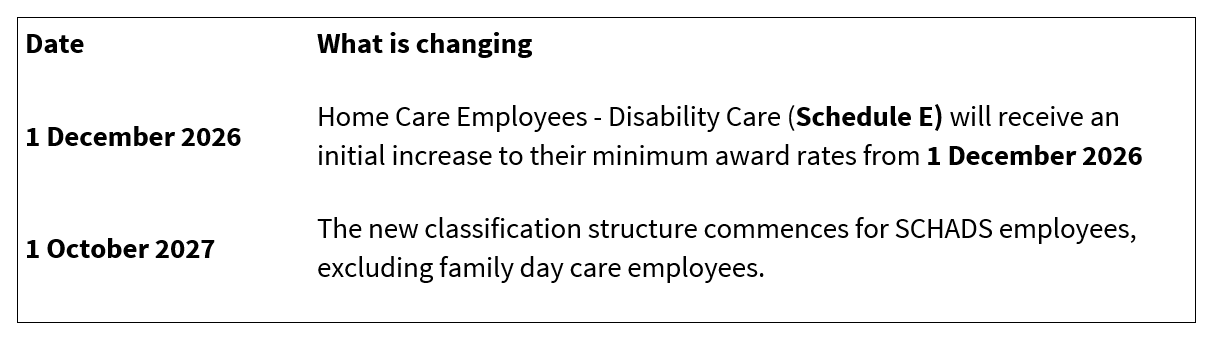
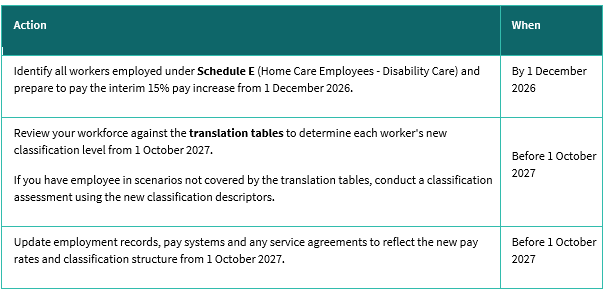
There are two key changes and dates employers need to prepare for:
Further details on these key changes is outlined below.
1 December 2026 — Pay increase for Home Care Employees - Disability Care (Schedule E)
If you have employees who currently provide personal care or support to people with a disability in their own home under Schedule E of the SCHADS Award, those workers will receive a pay increase of 15% from the first pay period on or after 1 December 2026.
There are two exceptions: Level E.4.2 will increase by 14.96%; and Level E.5.2 will increase by 13.31%.
The Commission has decided to defer the start of an interim 15% increase from 1 October 2026 to 1 December 2026 because of the absence of a Commonwealth funding commitment and the time required for NDIS providers to alter arrangements, including with clients.
Any remaining increases for these employees will apply from the commencement of the new classification structure on 1 October 2027.
1 October 2027 — New classification structure for SCHADS employees (excluding Family Day Care Employees)
From the first full pay period from 1 October 2027 the new classification structure (Schedule A— Classification Definitions) will commence on 1 October 2027 to replace the current:
Schedule B —Classification Definitions—Social and Community Services Employees
Schedule C —Classification Definitions—Crisis Accommodation Employees
Schedule E —Classification Definitions—Home Care Employees—Disability Care
Schedule F —Classification Definitions—Home Care Employees—Aged Care
Note: Schedule D—Classification Definitions—Family Day Care Employees will be renumbered Schedule C—Classification Definitions—Family Day Care Employees.
Here is an overview of the new levels and the pay rates under the new classification structure:
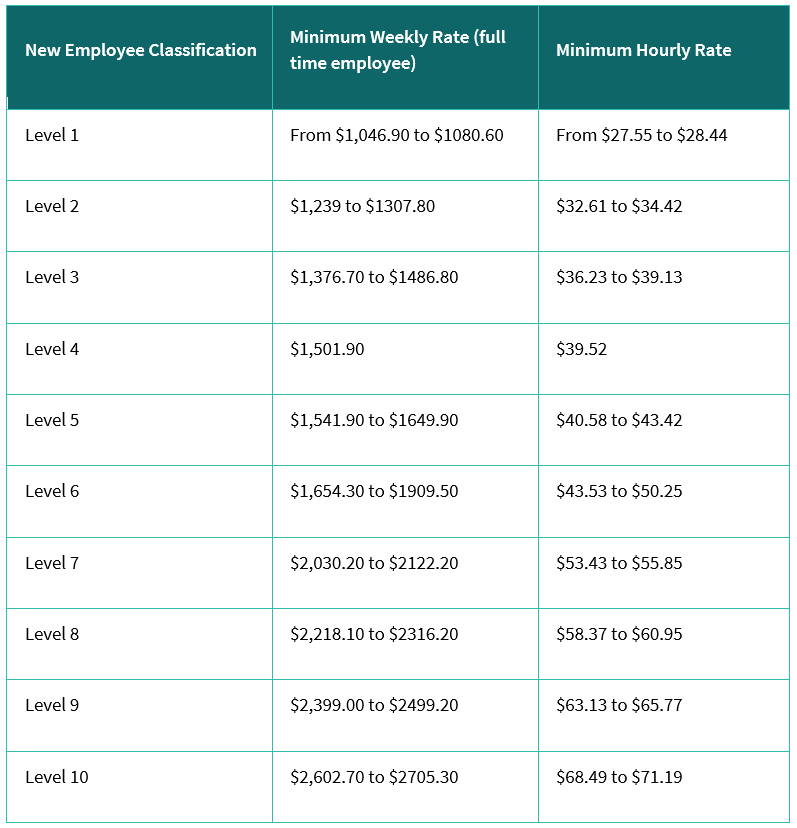
Note: These rates will be updated for the 2027 Annual Wage Review before the structure takes effect).
A final determination will be published closer to its operative date of 1 October 2027, updated for any changes arising from the 2027 Annual Wage Review, along with the order to revoke the Equal Remuneration Order.
How are employees moved to the new structure?
The Commission has published detailed translation tables that show how each current classification level maps to the new levels.
The tables are intended to be binding, not merely guidance, where they cover an employee’s circumstances. However, they are not exhaustive. If a scenario is not contemplated in the tables, the employer will need to undertake a classification exercise to apply the classification that best aligns to the employee's role, qualifications and experience immediately before the new structure commences.
Existing employees will not have their award minimum reduced. Their applicable minimum will be the higher of:
(a) the minimum rate for their translated classification, or
(b) the minimum rate that applied to them under the old award (inclusive of the Equal Remuneration Order where applicable) as at 30 September 2027.
You can access the translation tables at the following links:
For example - workers currently classified under Schedule F (Home Care Employees – Aged Care) will translate to the new structure — for example, a current Level 1 worker translates to new Level 2.1, and a current Level 6 worker translates to new Level 5.1.
Other points
Approach to Classifications
The Commission made it clear that classification of an employee under the new structure (like all classification structures) is determined by identifying the appropriate classification level for a particular employee given the role and the employee’s skills, knowledge and experience and not by the entry-level for a role.
Disability Support Workers
Under the new structure, disability support work falls under the social and community services stream, regardless of where that work is performed.
24-Hour Care Workers
The 24-hour care clause in the Award confirms that it applies to employees of employers in the home care sector and other employees engaged to provide personal care to a person with a disability in a private residence (see amended clause 25.8). This preserves existing practice for those who regularly use this arrangement. The Commission also flagged that the interaction between 24-hour care, sleepovers and broken shifts may require further review.
Summary - what do you need to do?
Final tip for employers
Check enterprise agreement and over-award arrangements in your contracts.
Employers should not assume that an existing rate or set-off arrangement automatically addresses the new minimum rates.
Sources: Fair Work Commission decision [2026] FWCFB 232 and Fair Work Ombudsman guidance.
This summary is intended as general information only and does not constitute legal advice. If you need specific advice about how this decision applies to your organisation, please seek legal guidance.